







Consultations and follow-ups are free
Several of the London pages we read say little or nothing about paradoxical adipose hyperplasia, the rare complication where the treated fat grows instead of shrinking. This guide is written by the team at our clinic in the Harley Street medical district and reviewed by our clinician. It gives you the figures from the manufacturer's own label and the published studies, the real London prices, and the honest answer to who it is not for.
What CoolSculpting is
CoolSculpting is the brand name of a cryolipolysis system made by Allergan Aesthetics, part of AbbVie. "Fat freezing" is the generic name for the same idea. Fat cells are more sensitive to cold than the overlying skin, which was first shown in pigs in 2008 and then in people. An applicator draws a fold of skin and fat into a cup and cools it to a controlled temperature, down to minus 11 degrees at the applicator, for 35 to 45 minutes. Surface applicators for areas that cannot be pinched go down to minus 13 degrees for 75 minutes. The skin is protected by a gel pad and the system monitors the temperature throughout.
Inside the fold, a proportion of the fat cells go through a natural cell death called apoptosis over the following days. The body then clears them through its normal inflammatory and immune pathways over weeks. Nothing is cut, injected or heated, and the studies that measured blood fats and liver tests found no clinically meaningful change.
In the US the system is cleared for nine areas: the flanks (2010), the abdomen (2012), the thighs (2014), under the chin (2015), bra fat, back fat, the banana roll under the buttock and the upper arms (2016), and under the jaw (2018). Since 2020 two applicators can run at the same time, which is what clinics call "dual sculpting". CoolSculpting Elite, launched in , is the current generation of the same cleared system with new C-shaped applicators; the manufacturer's release says they have up to an 18% larger cooling area and, in the next sentence, that the clinical significance of that has not been established.
Does CoolSculpting actually work?
Yes, within limits that are worth knowing before you pay.
- In the manufacturer's label, the study behind the original US clearance (about 50 people evaluated, on older, milder settings than today's, minus 4 to minus 10 degrees) measured an average 18.7% fat-layer reduction on ultrasound in the treated flank, normalised to the untreated flank, and three quarters of that change had happened by two months.
- Across the studies compiled in the manufacturer's current label, covering nearly 4,800 treatments, the mean fat-layer reduction is 20.6% on ultrasound (study averages ranged from 10.3% to 25.5%) and 22.3% by calliper.
- A large retrospective series of 518 patients in Belgium and France (Dierickx, 2013) measured a 23% reduction by calliper at three months against an untreated control site, with 73% of patients reporting satisfaction.
- Under the chin, the pivotal study of 60 people (Kilmer, 2016) measured a 2 mm reduction in the fat layer, which the manufacturer describes as about 20%, with 83% satisfied.
Two things those figures do not say. First, the percentage is of the fat layer in the treated spot, not of your body fat, and a fifth of a 3 cm bulge is 6 mm. Second, the figures are averages: some people get more, some less, and the label says people who are significantly overweight are less likely to see a meaningful change from a single cycle. In the studies in the manufacturer's label, blinded reviewers shown a before and an after photograph picked the right one 89.7% of the time on average, which says the change is visible but not how large it is.
What CoolSculpting does well:
- Reducing a pinchable bulge on the abdomen, the flanks, the inner and outer thighs, the upper arms, the back, under the bra line and under the chin.
- Doing it without a cut, a needle or an anaesthetic, in a lunchtime appointment.
What CoolSculpting does not do:
- It does not make you lose weight. The manufacturer's UK safety information says it is not a treatment for obesity and not a weight-loss procedure.
- It does not tighten loose skin. The only skin wording on the US label is that it "can also affect the appearance of lax tissue" under the chin, when it is used there for fat reduction.
- Cellulite is not among the cleared indications. The label says not to use it on the face, head, genitalia, groin creases, armpits, the back of the knee, the inner elbow, hands or feet, or where the fat layer is thinner than 1 cm.
Who CoolSculpting suits, and who it does not
The label is written for people with a body mass index of 30 or under for the body areas, and up to 46 for the chin and jaw. In our experience the best candidates are people close to the weight they want to stay at, with one or two firm, pinchable areas that do not move with exercise. Men do well on the flanks and the abdomen, and in our experience are often the most surprised by how much a stubborn bulge responds; the chest is not a cleared area.
The manufacturer's label lists three conditions in which the treatment is contraindicated, all of them rare blood conditions triggered by cold:
- Cryoglobulinaemia.
- Cold agglutinin disease.
- Paroxysmal cold haemoglobinuria.
The label also lists situations in which the treatment has not been studied or needs care, and a reputable clinic asks about every one of them. They are: children; pregnancy and breastfeeding; a known sensitivity to cold such as cold urticaria, Raynaud's or chilblains; a known sensitivity or allergy to fructose, glycerin, isopropyl alcohol or propylene glycol; poor circulation in the area; a nerve condition or reduced sensation in the area; an open or infected wound; a bleeding disorder or blood thinners; recent surgery or scar tissue in the area; a hernia in or next to the area, which the vacuum can make worse; and skin conditions such as eczema or dermatitis in the area. Pacemakers, defibrillators and breast or buttock implants are kept well away from the applicator. The label also notes that chronic pain, cold sensitivity or anxiety can make the session more uncomfortable.
If you have lupus, vitiligo or another condition the label does not name, bring your history. The US label does not name them, though the manufacturer's UK site says some autoimmune conditions rule treatment out, so the clinician decides case by case.
We do not offer Botox or dermal fillers. Our clinic works with what your body does for itself, and CoolSculpting fits that: the fat cells are cleared by your own immune system and nothing is put into you. The label does not list injectables as a reason not to treat, and we ask about them at the consultation.
Not sure you are suitable? Ask the clinician, it is free
What a session is like, step by step
- Consultation. The clinician pinches and photographs the areas, checks the list above, and works out how many cycles each area needs and which applicator fits it. You get the plan and the price in writing. Consultations and follow-up reviews are free.
- Preparation. In our practice you wear loose clothes and eat normally; there is no need to fast. The area is marked out and a gel pad goes on to protect the skin.
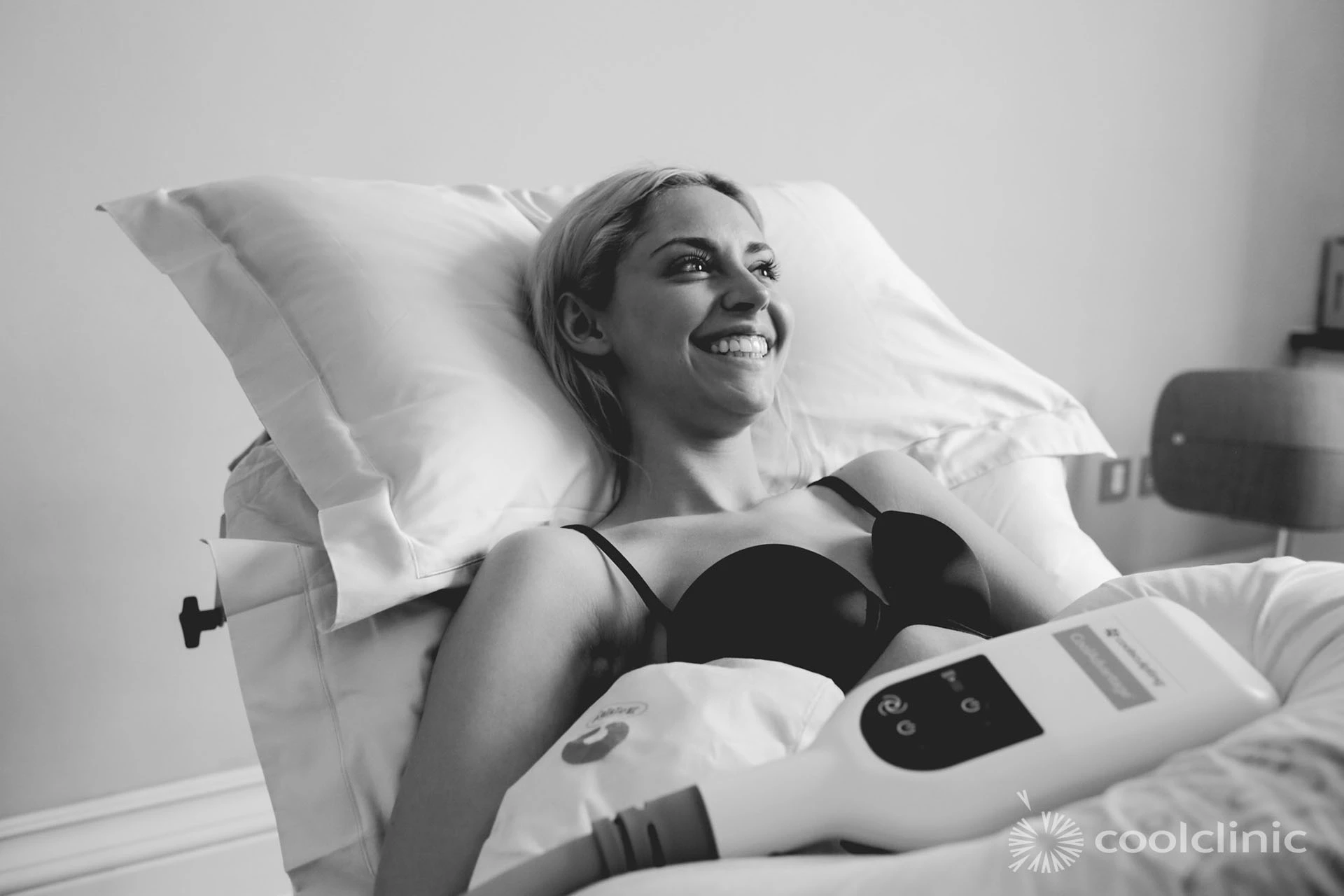
- The cycle. The applicator is placed and the vacuum draws the fold in. In our experience the first five to ten minutes bring pulling, then intense cold, tingling and aching, which the label says subside as the area becomes numb. After that most people read or rest. Two applicators can run at the same time on two areas.
- The massage. When the applicator comes off the fold is firm and cold. The clinician massages it for two minutes, as the label directs. In our experience this is the part most people find most uncomfortable. A study of ten patients (Boey, 2014) found 68% more fat reduction on the massaged side at two months, though a systematic review said the benefit of massage remains unclear.
- After. The area is red, firm and numb. The manufacturer says patients can typically return to normal activities, and in our experience you can drive, work and exercise the same day. A vacuum cycle takes 35 to 45 minutes and a surface cycle 75 minutes; a plan of several areas takes longer or is split over visits.
How many cycles, when you see the result, how long it lasts
| Feature | What to expect |
|---|---|
| Cycles per area | A 2022 expert panel (Delphi, 11 clinicians, Allergan-funded) gave typical minimums of two to four for most areas, three to five for the upper and lower abdomen, the back and the upper arms, and four to six for the flanks (no consensus). The label itself gives no number. Real-world data from one retrospective series (Friedmann, 2025, 3,262 patients, Allergan-linked authors): a median of four cycles per patient |
| Spacing | Four to eight weeks between cycles on the same area (the same panel) |
| First change | The original study puts three quarters of the change within two months; in our experience some people notice the area softening at three to four weeks |
| Main result | Judged about eight weeks after the last cycle (the panel); the manufacturer says results show within two to six months |
| How long it lasts | The manufacturer says the treated fat cells are gone, and the cells that remain can enlarge if you gain weight. The shape tends to hold while your weight holds, but no result is promised. The longest follow-up we found is two men, one flank each, photographed at nine years |
| Maintenance | The label asks for a healthy lifestyle afterwards and sets no maintenance schedule; a further cycle is possible later for the same area |
Is three cycles enough? For one small area, often. For an abdomen, usually not: the panel's starting point is three to five cycles across the upper and lower abdomen, and the flanks need their own. A single cycle on a large area buys a cycle, not a result. In our experience the people who are disappointed are the ones who had too few cycles on too large an area.
What CoolSculpting costs in London
CoolSculpting is priced per cycle, one applicator on one area for one session, and most areas need more than one. Among the London clinics whose pages we read in , single cycles are advertised from £250 (unit not stated) and £260 per cycle at the lower end. One City and Harley Street clinic lists £400 for the chin and £450 to £550 for standard applicators, with a four-cycle package at £1,980. A Mayfair clinic starts from £500 and its own guide estimates London at about £260 to £550 per cycle. Two other top-ranking clinics publish no prices at all, and directory sites list "from £700" without saying what that buys.
At our clinic the price depends on the areas and the number of cycles they need, so we quote it per area in writing at the free consultation, after the clinician has pinched and measured. We price match any comparable written quote, and finance through Humm is available, subject to status, with terms that depend on the amount. The consultation and every follow-up review are free whatever you decide.
A warning on cheap sessions. Cryolipolysis is a class of device, not one machine, and the published results above belong to the CoolSculpting system. A "fat freezing" session at a fraction of the price may be an unbranded machine with no published data, and frostbite from salon devices has been reported in the medical literature. Ask what machine it is, whether the applicator has the freeze-detection safety system, and who places it.
Consultations and follow-ups are free
Results you can check
Before and after photographs help most when they are dated and labelled by area. At your consultation the clinician can show you photographs of our own CoolSculpting patients, with their consent, and you can compare them with your own photographs at twelve weeks. We do not publish them here.
Patients have reviewed the clinic on review.clinic, where Cool Clinic holds 4.8 out of 5 from 54 reviews, with 100% saying the treatment was worth it (). The reviews that mention the number of cycles are the most useful ones to read.
CoolSculpting compared with the alternatives
| Feature | CoolSculpting | EMsculpt NEO | Liposuction |
|---|---|---|---|
| What it does | Cools and removes a proportion of the fat cells in a pinchable bulge | Heats fat and contracts muscle with radiofrequency and electromagnetic pulses | Surgically removes fat |
| Sessions | 2 to 6 cycles per area depending on the area, 4 to 8 weeks apart | 4 sessions, about a week apart (clinic practice; the sham-controlled trial used three weekly sessions) | 1 operation |
| Downtime | No time off work; redness, bruising and tenderness for one to two weeks and numbness for two to three weeks on average | None; muscle soreness for a day or two | Weeks; up to six months to settle |
| Fat change | Fat layer about a fifth thinner on average in the manufacturer's compiled studies | About 28% fat-layer and 24% muscle-thickness change at three months on ultrasound in a sham-controlled trial by BTL's medical advisors; independent reviews put the average abdominal change at about 5 to 8 mm of fat | Surgical removal of fat volume; no like-for-like trial against the other two |
| Rare risks | Paradoxical fat growth, freeze burn, late-onset pain, hernia | The FDA summary lists mild redness and muscle soreness; no serious events were reported in the studies we read, which are small and mostly by BTL advisors | Bleeding, uneven results, numbness lasting months, changes in skin colour, a blood clot in the lungs |
| Best for | A firm, pinchable bulge; the chin; the flanks | A softer layer over a muscle you also want toned; people who cannot pinch a fold | Large volumes, surgical reshaping |
The session numbers, downtime and "best for" rows reflect our clinical experience and the sources named; the "fat change" row gives each manufacturer's own study figures, with the independent reviews named where they exist.
CoolSculpting vs EMsculpt NEO. They do different things and we run both. CoolSculpting removes fat cells from a fold you can pinch and does nothing for the muscle underneath. EMsculpt NEO works the muscle and warms the fat layer over four short sessions, and in a trial by the manufacturer's medical advisors reduced the abdominal fat layer by about 28% on ultrasound at three months. It is not cleared for the chin. For a pinchable bulge we start with CoolSculpting; for a soft abdomen after pregnancy where the muscle has slackened, EMsculpt NEO; and for some people one after the other. We found no study that has compared them.
CoolSculpting vs liposuction. In our view liposuction removes far more fat in one go and can reshape, at the cost of surgery, anaesthesia, weeks of swelling and compression garments. CoolSculpting is for the person who does not want surgery and has a modest bulge. In our view, if the bulge is more than a few centimetres thick, liposuction is the honest answer and we will say so.
CoolSculpting vs other fat freezing. The device matters. The US clearance and the studies above are for the CoolSculpting system; other cryolipolysis machines have not been assessed in this guide and some have no published data.
Consultations and follow-ups are free
Side effects, and the risks nobody writes about
Most people have redness, firmness, bruising, swelling and tenderness in the treated area for one to two weeks, and numbness or tingling that lasts two to three weeks on average; in the pivotal study 8% still had altered sensation at two months. Aching and cramping in the first days are common, and in our experience respond to ordinary painkillers. After a chin treatment the label lists throat discomfort for a short while.
The label lists rare events, and the manufacturer's UK safety information () gives complaint-based per-cycle rates for them. Late-onset pain starting several days after a cycle and lasting weeks: about 1 in 6,000. Severe pain: about 1 in 6,000. Darker skin colour (hyperpigmentation): about 1 in 11,000. Freeze burn, including very rare second and third degree burns: about 1 in 15,000. A visible step or contour change at the edge of the treated area: about 1 in 20,000. Fainting or nausea during treatment: about 1 in 30,000. Firm lumps under the skin (subcutaneous induration): about 1 in 30,000. Cold panniculitis, a deeper tissue injury that can include fat necrosis and may need medical or surgical treatment: about 1 in 60,000. A new or worse hernia: about 1 in 185,000.
The one to understand is paradoxical adipose hyperplasia, PAH. Two to five months after a cycle the treated area grows instead of shrinking, into a firm swelling in the shape of the applicator, usually not painful, that has not been seen to resolve on its own. The manufacturer's UK safety information () gives about 1 in 3,000 cycles. Independent series have reported it more often: about 1 in 210 treatments (2 in 422, Singh 2015) and about 1 in 100 patients (4 in 398, Stroumza 2018). A 2025 meta-analysis of 28 studies and 13,078 patients put the pooled rate at about 1 in 455 patients, on low-certainty evidence. More cases have been reported in men, though the meta-analysis found that difference not statistically significant. In 2022 the manufacturer withdrew its older parallel-plate applicators in the US after a rise in PAH complaints (FDA recall record). A 2021 Canadian study found PAH rates fell by more than 75% with newer models of unit, but nobody has shown the risk is gone. PAH is usually treated with liposuction, once the area has softened at six to nine months. It can appear up to five months after a cycle, so contact us at any point if the area gets bigger and we will look, free of charge. We also review every patient at twelve weeks and invite you back later, because a published series advises follow-up for at least six months.
That is the honest answer to "what is the downside of CoolSculpting". For most people the downside is two weeks of numbness and bruising. For a small number it is a complication that may need surgery to fix.
How to choose a CoolSculpting clinic in London
- Ask what machine it is. A genuine CoolSculpting system, with the freeze-detection safety system; ask to see the applicator branding. Ask whether the clinic has moved to the current Elite applicators or still runs older ones. FDA clearance is a US status; ask any clinic for the device's UK conformity documentation.
- Ask who places the applicator and who supervises. Our sessions are run by trained clinicians in a doctor-led team, and this guide is reviewed by Dr Marie Duggan, GMC 7488383.
- Ask for the plan in cycles, per area, in writing. A price for "a session" without a cycle count is not a plan.
- Ask about PAH before you are asked to sign. If the clinic cannot tell you what it is, go elsewhere.
- Check the regulator. Ask whether the clinic is CQC registered; ours is, registered at our group's Harley Street address while the registration moves to 8 Devonshire Place.
- Ask for the clinic's own photographs, dated and labelled by area.
Aftercare
Our aftercare is simple. Drink normally, keep moving, and take paracetamol or ibuprofen if the area aches. Wear something soft over the area for a few days. Leave the numb patch alone and do not use a heat pad or an ice pack on it. Exercise is fine from the same day. Keep your weight stable through the twelve weeks, because the result is measured against it. Come to the free review at twelve weeks, and come sooner if the area swells, blisters or changes colour. These are our protocols; the manufacturer's label itself asks only for the two-minute massage and a healthy lifestyle afterwards.
Consultations and follow-ups are free
Frequently asked questions
How much does CoolSculpting cost in the UK?
In London a single cycle is advertised from about £250 to £550 depending on the clinic and the applicator, which puts four cycles at about £1,040 to £2,200. Most areas need more than one cycle. We quote per area in writing at a free consultation, price match any comparable written quote, and offer finance through Humm, subject to status.
Is CoolSculpting actually worth it?
If you have a firm, pinchable bulge, a stable weight and the patience to wait three months, it can be: the manufacturer's compiled studies show an average fat layer about a fifth thinner on ultrasound, and most people in them were satisfied. If you want to lose weight, or your skin is loose rather than your fat thick, the money is better spent elsewhere, and we will tell you which at the consultation.
What is the downside of CoolSculpting?
Two weeks of numbness, bruising and tenderness for almost everyone, and a rare risk of paradoxical adipose hyperplasia, where the treated fat grows instead of shrinking and may need liposuction to correct. The manufacturer puts PAH at about 1 in 3,000 cycles; independent studies have found it more often, up to about 1 in 100 in some series.
Is 3 CoolSculpting sessions enough?
For one small area such as the chin or a single flank, often yes. For a whole abdomen, usually not: the expert panel's typical minimum is three to five cycles across the upper and lower abdomen, with the flanks on top. The honest number comes from pinching and measuring, which is what the free consultation is for.
What is CoolSculpting, in one sentence?
An FDA-cleared medical device that cools a pinched fold of fat to a controlled low temperature for 35 to 45 minutes so that a proportion of the fat cells die and are cleared by the body over the following weeks to months.
How much thinner does the fat layer get?
In the manufacturer's label compilation the treated spot measured about 20.6% thinner on average on ultrasound (study averages 10.3% to 25.5%), and 18.7% in the original flank study. That is a thickness change in one spot, not a change in your weight.
Does the fat come back after fat freezing?
The manufacturer says the treated fat cells are gone. The cells that remain in the area can enlarge if you gain weight, and the manufacturer says so too. Keep your weight stable and the shape tends to hold; the longest follow-up we found is two patients photographed at nine years.
Does CoolSculpting hurt?
The first five to ten minutes of pulling and intense cold are unpleasant, then the area goes numb. In a single-clinic study of 91 Elite patients, 78% rated the discomfort 1 or 2 out of 5 and 3% scored it 4 or 5. The two-minute massage afterwards is, in our experience, the part most people dislike. Severe pain is a rare listed event.
Is there any downtime?
Usually no time off work. Expect redness and firmness on the day, bruising and swelling for one to two weeks, and numbness for two to three weeks on average. You can exercise the same day.
Which areas can be treated?
The abdomen, the flanks, the inner and outer thighs, the upper arms, the back, the bra line, the banana roll under the buttock, under the chin and under the jaw. Not the face, hands, feet or any area where the fat layer is under a centimetre thick. Other areas are not cleared; ask at the consultation.
Can I have CoolSculpting with lupus, vitiligo or another condition?
The label rules out three rare cold-triggered blood conditions and lists cold sensitivity, poor circulation, nerve conditions, hernia, skin disease at the site and pregnancy as reasons for caution. Lupus and vitiligo are not named in the US label, though the manufacturer's UK site says some autoimmune conditions rule treatment out; bring your history and the clinician decides case by case at the consultation.
Is CoolSculpting safe while pregnant or breastfeeding?
It has not been studied in pregnancy or breastfeeding, so we do not treat until afterwards.
Is CoolSculpting FDA approved?
It is FDA-cleared in the US, which is a different thing from approved, for the flanks (2010), abdomen (2012), thighs (2014), under the chin (2015), bra fat, back, banana roll and upper arms (2016) and under the jaw (2018). CoolSculpting Elite is the current generation of the same cleared system.
CoolSculpting or EMsculpt NEO?
CoolSculpting for a fold you can pinch; EMsculpt NEO for a softer layer over a muscle you also want toned. They do different things, we found no trial that has compared them, and some people have both. We run both and we will tell you which fits.
Do you treat men?
Yes. Flanks and abdomen are the usual areas. Note that more cases of PAH have been reported in men, though the 2025 meta-analysis found the difference not statistically significant. Either way, come to the twelve-week review and the later check.
How long between sessions, and can I do two areas at once?
Four to eight weeks between cycles on the same area. Two applicators can run at the same time, which shortens the time in the chair; the number of cycles each area needs does not change.
Where is the clinic and how do I book?
Cool Clinic, 8 Devonshire Place, London W1G 6HP, in the Harley Street medical district, a few minutes from Regent's Park and Great Portland Street stations. Consultations and follow-up reviews are free. Call 0207 043 1117 or use the form below. If you would rather we reply by e-mail only, say so in the message box of the question form on our homepage and we will.
